


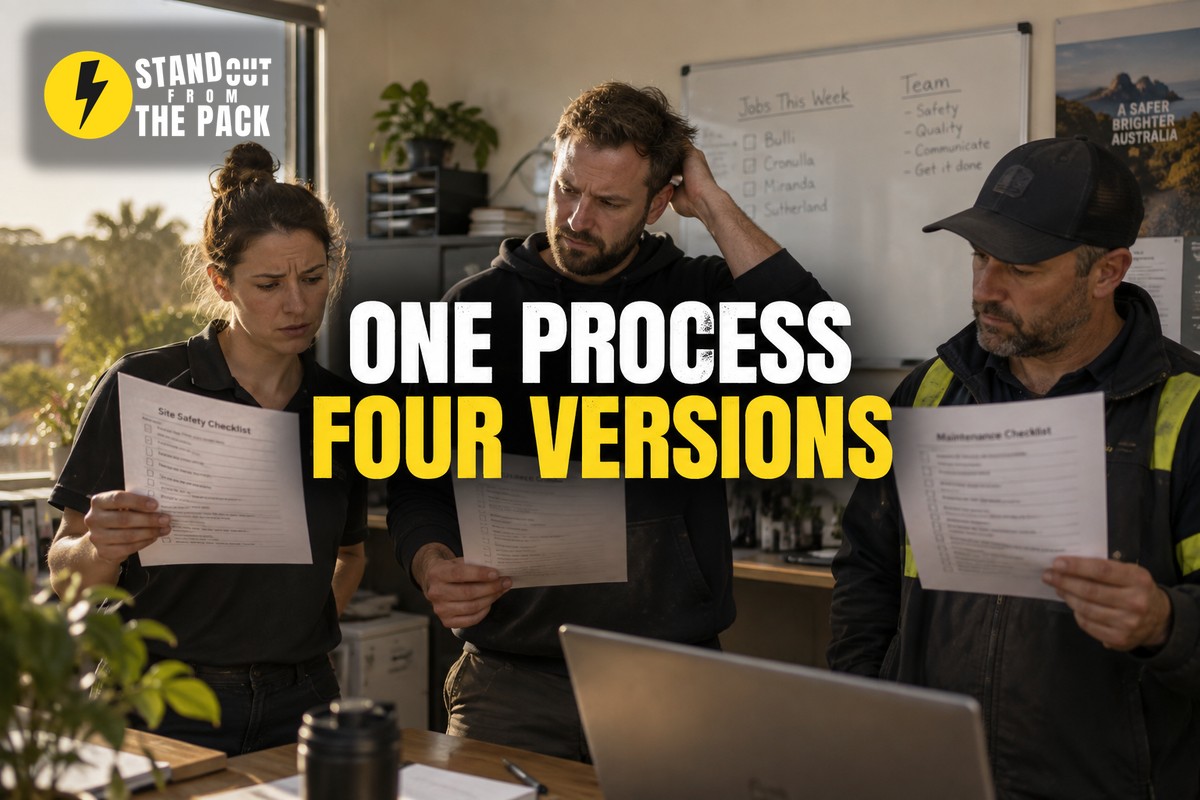
Which Version of the Process Is Your Team Actually Following?
Quick story, or rather a pattern I keep running into.
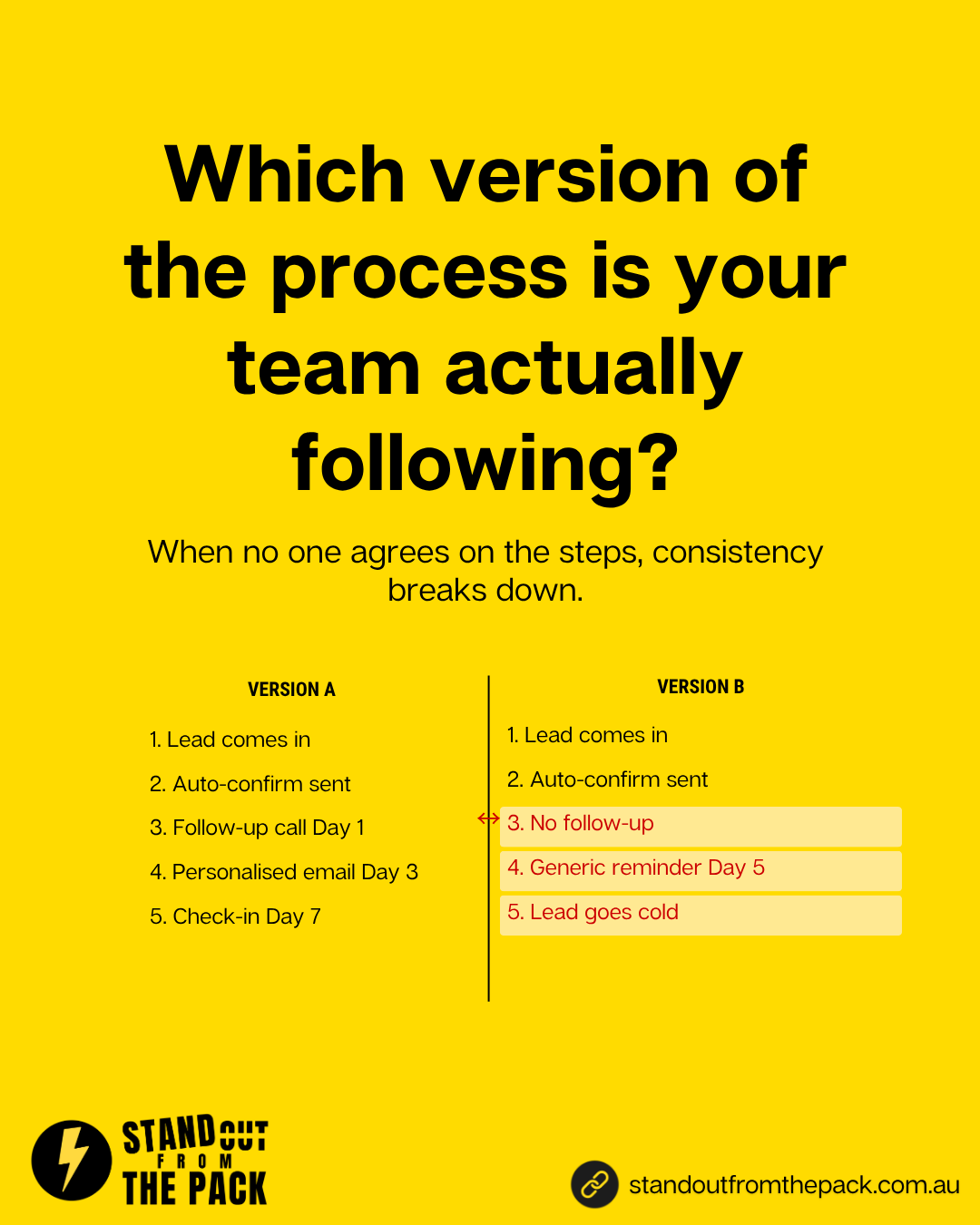
An owner tells me, with complete confidence, "we have a process for new enquiries". And to be fair, they do. It was written up about eighteen months ago, after a planning day. Lead comes in, confirmation goes out, follow-up call on day one, personalised email on day three, check-in on day seven. Lovely.
Then we ask the team to walk us through what they actually do.
The first person follows it pretty closely, because she helped write it. The second person has an older copy saved on her desktop, from before the day three email was added. The third person uses a follow-up message template he tweaked a while back "because the old one sounded a bit stiff", and nobody else knows it exists. And the newest team member learned the process by watching whoever happened to be sitting next to him in his first week.
Same business. Same process, officially. Four different versions running at the same time.
And the customer? The customer gets whichever version they happen to land on. One lead gets a call the next day and a thoughtful email. Another gets a confirmation, then nothing, then a generic reminder on day five, and then quietly goes cold.
Nobody did anything wrong on purpose. The process just lived in people's files and heads instead of in the system they work from. And a process that lives in files does not stay one process for very long.
Why does one process turn into several versions?
Because every copy of a process starts drifting the moment it is saved somewhere new.
Documents get copied, not shared. Someone downloads the checklist to "have it handy". Now there are two. The next update goes into one of them, and the other carries on as if nothing changed.
People improve things privately. A team member rewrites a template because it works better for them. Genuinely good instinct. But the improvement stays in their drafts folder, so the business gets the benefit only when that one person is working.
Changes go out as messages. "Hey team, from now on we are calling on day one, not day two." Everyone reads it, most people remember it for a fortnight, and the new person who starts next month never sees it at all.
Old versions are never deleted. They linger "just in case", on desktops, in email attachments and in a shared folder called "Processes FINAL v3". And sooner or later, someone uses them.
This is why "we need to write our processes down" is only half the answer. Written down is better than nothing. But written down in five places is how you end up with five processes.
How do you create one source of truth your team actually follows?
The idea is to stop describing the process in documents and start running it inside the system your team already works in. When the checklist, the templates and the follow-up steps live there, there is only one version, and changing it once changes it for everyone. Five steps.
1. Pick one process and write down what really happens. Start with the one that affects customers most, usually new enquiries. Sit with the team and map what each person actually does, step by step, including the workarounds. You are looking for the differences between people. Those differences are your drift.
2. Agree on the best version, together. Take the best bits from each person. That tweaked template that sounds more human? It probably becomes the new standard. When the team helps choose the version, they are far more likely to follow it.
3. Turn the checklist into tasks the system creates automatically. Instead of a checklist someone has to remember to open, a new enquiry creates the tasks: call on day one, assigned to the right person, with a due date. When the task is done, the next step appears. Nobody needs a printout.
4. Move every template into one shared library. Emails, text messages and call notes live as shared templates in your CRM, not in anyone's drafts. Everyone uses the same one, and when someone improves it, it gets improved in the library, where the whole team benefits by the next enquiry.
5. Let the follow-up run as a workflow. The confirmation, the day three email and the day seven check-in go out automatically, at the right time, whether it is a quiet Tuesday or the busiest week of the year. Your team handles the conversations. The system handles the timing.
Then comes the part most businesses skip: delete the old versions. The desktop copies, the attachments, the "FINAL v3" folder. If a document still describes the process, it should point to the system, not compete with it.
What usually goes wrong?
The system gets built, but the old habits stay. The workflow sends the day three email, and one team member still sends her own version too, out of habit. Now the customer gets two. When the process moves into the system, tell the team clearly what they no longer need to do.
Changes are made without telling anyone why. Someone adjusts the workflow and the team notices things behaving differently without knowing why. A short note, "we changed this, here is why, here is what you do differently", keeps everyone on the same page.
Everything is moved at once. Trying to rebuild every process in a month usually ends with half of them finished and the team confused about which ones are live. One process at a time, properly, then the next.
Nobody owns the process. When everyone can change a template and nobody is responsible for it, you are back to drift, just inside the system instead of outside it. Give each core process one owner.
The process is set up once and never reviewed. Businesses change. Services change. A process that was perfect a year ago can be quietly wrong today. A short review every quarter keeps it honest.
Why is this better than the alternatives?
"We have a procedures manual." Great for reference and training. But a manual describes the process. It does not run it. On a busy day, people do what is in front of them, and if the manual is not in front of them, it is not being followed.
"We do regular team training." Training helps people understand why the process matters. It does not stop the older copy on someone's desktop from being used next Thursday. Training plus a system that holds the process is where consistency comes from.
"Everyone knows what to do, we are a small team." Everyone knows their version. And in a small team, the gaps between versions are even harder to spot, because nobody sees anyone else's work until a customer complains.
When the system holds the process, consistency stops depending on memory, and improving the process becomes simple: change it once, and everyone is using the new version from the very next enquiry.
How does this work inside Stand Out From The Pack?
Everything above is shared templates, pipeline stages that create tasks, workflows that send the follow-up on schedule and a few user permissions so templates are not edited by accident. Every customer on every plan has those tools from day one. The difference is who sets them up.
- Do it yourself, with support. Every plan includes onboarding for the owner and the team, including a team training call, plus a knowledge base with 50 plus interactive guides, 24/7 live chat with real people and weekly Open Office Hours (all on our support page). Bring your current checklist to Office Hours and we will help you turn it into tasks and workflows, live.
- Get the foundations done for you. Our done-for-you account setup puts your pipeline, team access and connected channels in place properly, so there is one solid system for the process to live in.
- Have us build it. Task-creating pipelines, shared template libraries and follow-up workflows are built into the systems in our Profit Roadmap. A single job like "turn this checklist into automatic tasks" sits on our services menu, and anything more involved becomes a custom project.
However you get there, the result is one version of each process, running the same way for every customer, no matter who is working that day.
This one pairs nicely with last week's article on how your team already knows where the process breaks. That piece is about spotting the problems. This one is about making sure the fix reaches everyone, and stays fixed.
What just happened behind the scenes of this article?
A short aside, because we should be the proof of what we preach.
Today's social post asked you to comment SYSTEM. When you do, an automation picks up your comment, sends you a direct message within a minute with this article, and opens a conversation in our inbox with your name and the topic attached.
Here is the relevant bit. That direct message comes from one shared template. When we improve the wording, we change it once, and the very next person who comments gets the new version. Nobody on our team has a private copy of the reply saved somewhere, and there is no "old version" floating around. One process, one source of truth, running the same way whether it is 9am on a Monday or 11pm on a Saturday.
It runs in our own account on the same platform our customers use, built the way any of them could build it, or have us build it for them.
A quick check for your own business
- Ask two team members to describe your enquiry process separately. Do their answers match?
- Where do your email and text templates live, and how many copies of each exist?
- When you last changed a process, how did the team find out?
- Who owns each of your core processes?
- How many old process documents are still saved somewhere, waiting to be used by mistake?
Frequently asked questions
Do I still need written process documents? A short overview is useful for training and context. Just make sure it describes the process and points to where it runs, rather than acting as a second version of it.
Which process should we move into the system first? The one that touches customers most often, usually new enquiry follow-up. It has the biggest impact and it is where inconsistency costs you the most.
What if a team member's version really is better? Brilliant. Make it the standard. Put it into the shared template or workflow so everyone benefits, and thank them for it. That is exactly how good processes get better.
How often should we review our processes? A quick review every quarter is plenty for most small businesses. Check where records stall, which questions customers keep asking, and whether anyone has started working around the system again.
Want every customer to get the same great version of your process? Comment SYSTEM on the post on Facebook or Instagram and we will take it from there.




Live, Practical, Zero Jargon
Short sessions on follow-up, systems and AI you can put to work the same afternoon. Get on the list and we'll tell you when the next one's on.
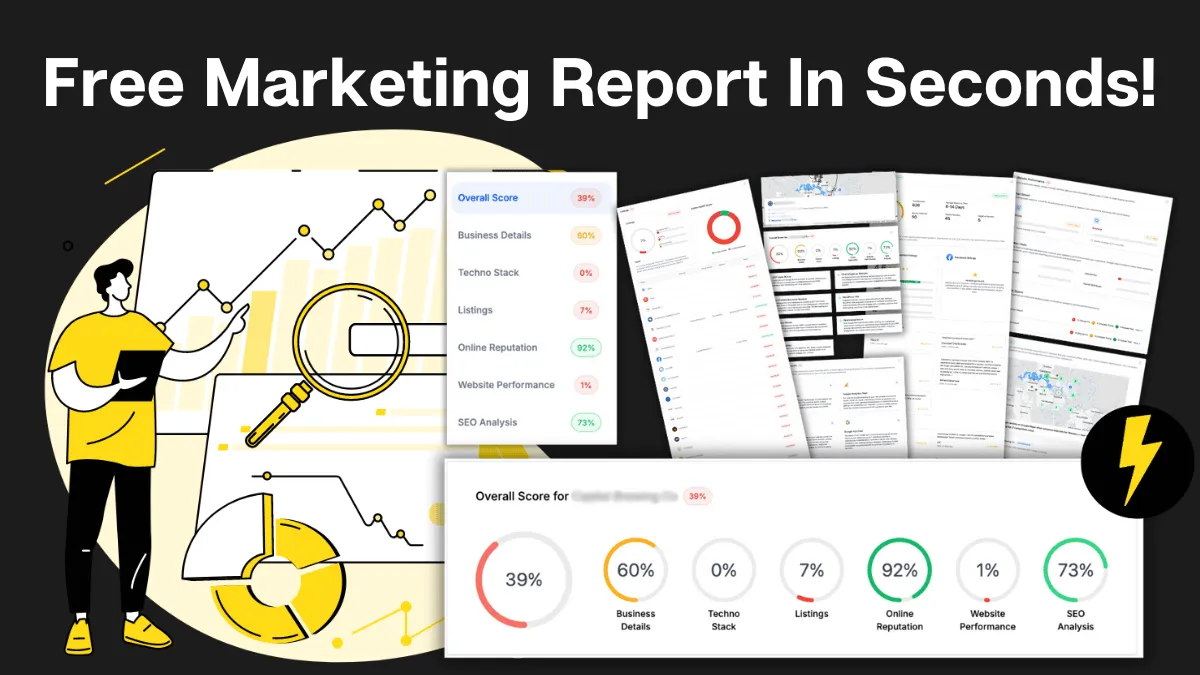
How Do You Stack Up Against the Business Down the Road?
See how you show up online next to competitors near you: reviews, listings, visibility. Free, and no homework required.

Supercharge Your Business!
Transform your business growth with our all-in-one sales and marketing software. Capture, nurture, and close more leads with ease. Don't miss out on the opportunity to streamline your operations and drive success.

See It Working Before You Talk to Anyone
Watch an enquiry get caught, answered and booked in without you glued to your phone. Your pace, no pressure.

Never miss an update from Business Booster Insights. Subscribe to our 'Level Up Newsletter' and get expert tips, strategies, and exclusive content delivered straight to your inbox. Elevate your business game today!

Your Clients Need Better Follow-Up. You Could Earn From It.
Accountants, coaches and consultants spot leaky businesses every day. Recommend the fix and earn ongoing commission.

Where Are Your Enquiries Going Cold?
Answer a few quick questions and see exactly where leads slip between "just asking" and "let's book." Takes less time than your next coffee order.
Still Handing Out Cards That End Up in the Wash?
Share your details in one tap so people can save you, call you or book you on the spot. Yours free.